
Aerospace · Surface modeling
Rocket Nose Cone
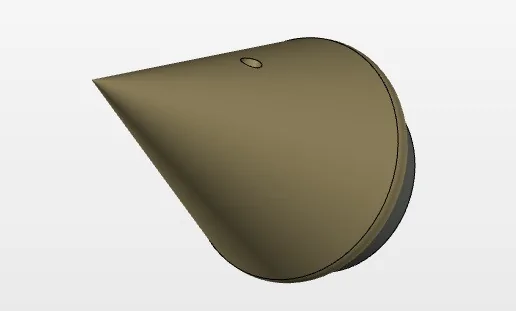
A clean nose-cone surface model developed to define profile, continuity, attachment geometry, and reviewable shape.
01Defined challenge
02Visible approach
03Controlled next step
The challenge
Make the engineering problem visible
Apparently simple rotational surfaces can be sensitive to profile definition, continuity, wall strategy, attachment, internal packaging, and the manufacturing process selected for the final component.
Approach
Structure the work around decisions
- Define governing axes, profiles, and interface references.
- Build clean surface geometry suitable for visual and dimensional review.
- Resolve the transition to the attachment region and any access features.
- Prepare the geometry for later analysis, detailing, or prototype export.
A controlled surface model provides a stable basis for the next decisions without over-claiming aerodynamic or structural performance that still requires specialized analysis and validation.
Portfolio note
Performance, flight suitability, and compliance require program-specific engineering, analysis, testing, and approval beyond portfolio imagery.
Related capability: 3D Engineering Design.
Start a project
Put your project on the board.
Aurea can begin from a sketch, a legacy part, an existing model, or a production problem. The first task is defining what must be learned next.